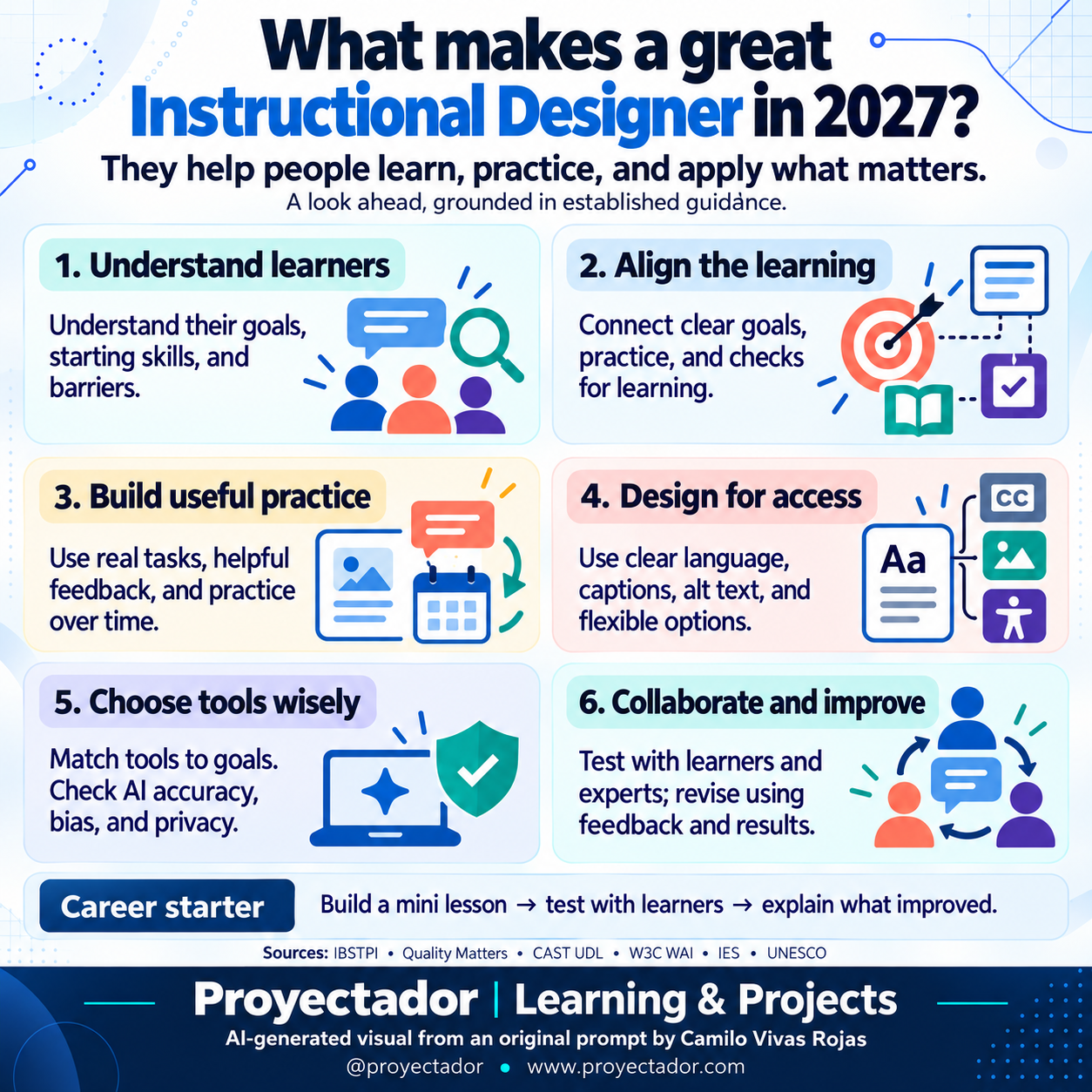
What makes a great Instructional Designer in 2027?
What should someone be able to do after a learning experience—and what support will help them get there?
1. Understand learners. Understand their goals, starting skills, and barriers.
2. Align the learning. Connect clear goals, practice, and checks for learning.
3. Build useful practice. Use real tasks, helpful feedback, and practice over time.
4. Design for access. Use clear language, captions, alt text, and flexible options.
5. Choose tools wisely. Match tools to goals. Check AI accuracy, bias, and privacy.
6. Collaborate and improve. Test with learners and experts; revise using feedback and results.
A small way to begin
For a first portfolio project: Build a mini lesson → test with learners → explain what improved.
Sources & context
2027 is an editorial outlook based on established guidance, rather than an employment forecast.
- IBSTPI — Instructional Designer Competencies
- Quality Matters — Higher Education Course Design Rubric
- CAST — Universal Design for Learning Guidelines
- W3C WAI — Writing for Web Accessibility
- IES — Organizing Instruction and Study to Improve Student Learning
- UNESCO — Guidance for generative AI in education and research